Exactly-Once in Kafka — Deep Dive
Published
Your bar: on a whiteboard, derive why committing the consumer’s input offset inside the producer’s transaction makes a read-process-write loop exactly-once — and name the exact byte where the guarantee evaporates. Grounded in KIP-98, KIP-447, Confluent’s canonical write-up, 3 and Kleppmann’s DDIA ch.11. 4
One sentence holds the whole lesson. Each level unpacks one chip of it:
Kafka EOS is exactly-once processing, not delivery
for the read-process-write loop
built from dedup + atomic txn + read_committed + fencing
and it stops at Kafka’s edge
What EOS actually promises (and doesn’t)
Get the scope wrong and you’ll ship a pipeline that thinks it’s exactly-once and quietly isn’t.
It is Exactly-once processing for the read-process-write pattern, entirely within Kafka: each input affects the output exactly once, across crashes and retries.
It is not Exactly-once delivery (impossible), not across a chain of external systems, and not a way to make “charge a card” happen once.
✓ Exactly-once effects: each input affects the Kafka output once
🎯 Memory rule: EOS = exactly-once effects for Kafka→process→Kafka, from three mechanisms that must interlock — miss one and it duplicates in prod.
Memory check
- Processing or delivery? → processing/effects; delivery is impossible (Lesson 2)
- What shape does it cover? → read-process-write, Kafka in → Kafka out
- How many mechanisms interlock? → four: dedup, atomic txn, read_committed, fencing
The idempotent producer — PID + sequence numbers
Smaller problem first: a producer retries a send — did the first one land? Dedup it at the broker.
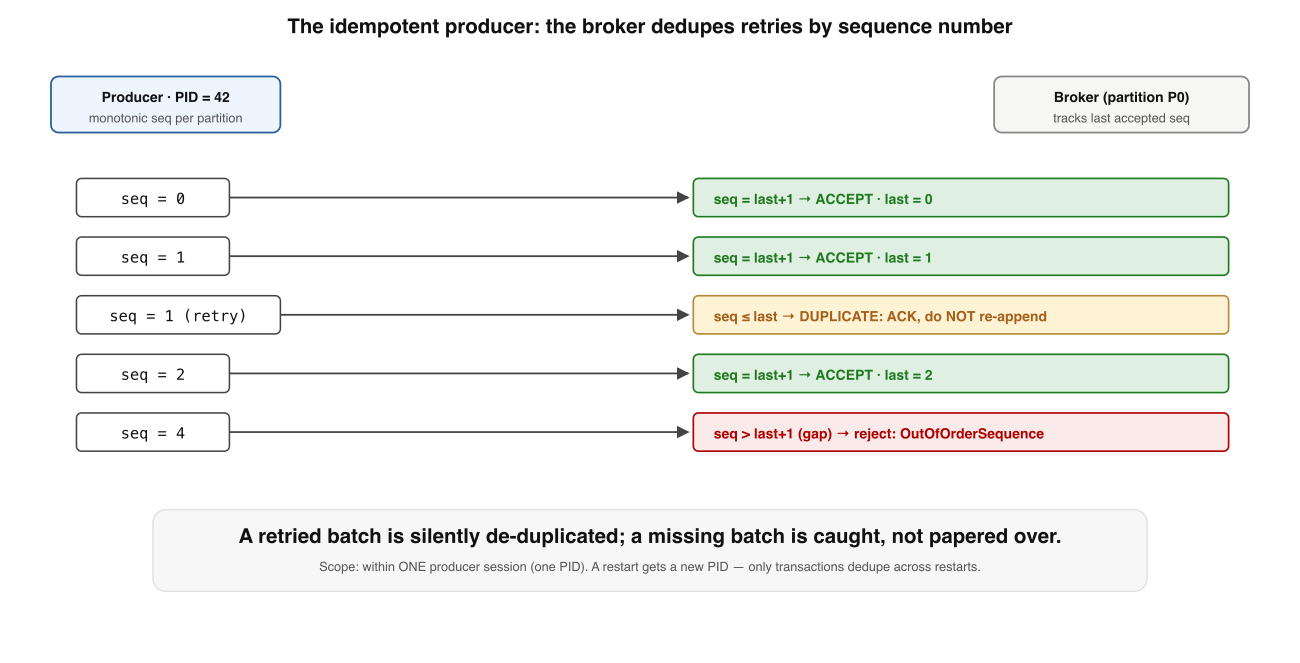
The idempotent producer. Each batch carries a per-partition sequence number. The broker tracks the last one it accepted: a retry with an already-seen sequence is ACKed but discarded (dedup); a gap means data was lost, and the broker rejects it.
How On startup the broker assigns a Producer ID (PID); each
batch carries a monotonic sequence number per
(PID, partition) from 0.
enable.idempotence=true — default since Kafka 3.0.
Why it needs ordering Requires acks=all and
max.in.flight.requests ≤ 5 so the broker can dedupe the last few batches
and keep them in order.
Like (code) An idempotency key on a POST — the server remembers the last key and silently drops the replay (Part 1, Lesson 2).
The scope limit Dedupes retries within one producer session (one PID). A process restart gets a new PID → old state no longer matches → cross-restart dupes slip through.
✓ Only within one PID’s life; restart → new PID → transactions close the gap
🔢 Memory rule: Per-(PID, partition) sequence numbers — ≤ last is a dropped retry, last+1 accepts, > last+1 is a rejected gap.
Memory check
- Three broker verdicts on a sequence number? → ≤ last drop, last+1 accept, > last+1 reject
- Why
acks=all+ bounded in-flight? → so dedup keeps ordering of the last few batches - What breaks across a restart? → new PID; old per-PID dedup state no longer matches
Transactions — the loop made atomic
The whole trick: the output writes and the consumer’s input offset commit all-or-nothing.
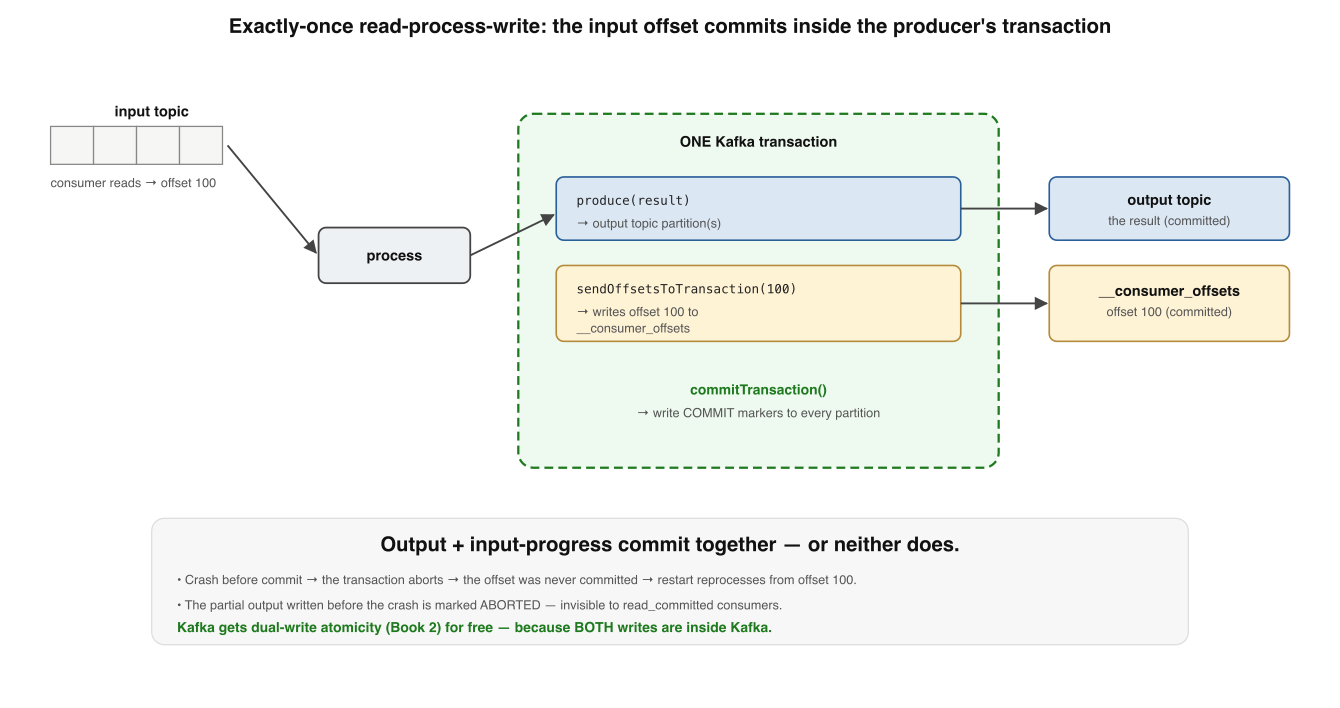
The exactly-once read-process-write loop. The producer writes its output AND commits the consumer’s input offset inside ONE transaction. Commit writes markers to every partition. A crash aborts both, so on restart you reprocess from the last committed offset and the partial output is invisible.
beginTransaction()
produce(outputTopic, result)               // 1+ output partitions
sendOffsetsToTransaction(inputOffsets, ...)  // the consumer's progress  ← the trick
commitTransaction()                            // markers to every partition, visible together
Setup A stable transactional.id survives restarts;
initTransactions() registers it with a
transaction coordinator (a broker, backed by
__transaction_state).
The atomic set sendOffsetsToTransaction writes input offsets into
__consumer_offsets as part of the producer’s transaction — so
output
and “we consumed those inputs” rise or fall together.
Commit The coordinator writes commit markers (control records)
into every involved partition — outputs and __consumer_offsets — and the
whole thing becomes visible at once.
Crash trace Produce output, die before commit → txn aborted → offsets never committed → restart reprocesses from last committed offset; the partial output is marked aborted, invisible.
✓ It gets all-or-nothing only because both writes are inside Kafka, in one txn
🔗 Memory rule: Output + input-offset commit in one transaction — the offset and the output rise or fall together, so reprocess-after-crash never double-counts.
Memory check
- What does the transaction atomically contain? → output records + the input-offset commit
- Where do offsets actually get written? →
__consumer_offsets, inside the txn - After a pre-commit crash, where does it resume? → last committed offset; partial output is aborted
read_committed and the Last Stable Offset
Producing transactionally is only half. The reader must opt in — or the duplicates leak anyway.
read_committed never reads past it, and filters aborted records via the broker's
markers.
read_committed Delivers only committed transactions, never reads past the Last Stable Offset, and filters aborted records using the broker’s abort markers.
read_uncommitted (default)
Returns everything — committed, aborted, and in-flight. A txnal producer with a default-isolation consumer is not EOS.
EOS is a whole-pipeline property Transactional producer and
read_committed consumer. One without the other looks right in testing,
duplicates in prod.
The cost Adds read latency: a consumer can’t advance past an open txn, so a long-running transaction stalls its consumers at the LSO.
✓ Not unless every downstream consumer is also read_committed
🚧 Memory rule: A reader must be read_committed to honor EOS — it stops at the LSO and drops aborted records; the default sees the dupes the txn was meant to hide.
Memory check
- What is the LSO? → offset just before the first still-open transaction
- What does the default isolation level return? → everything: committed + aborted + in-flight
- Cost of
read_committed? → stalls at LSO behind a long open transaction
Zombie fencing — the transactional.id and the epoch
The genuinely distributed part: Part 1’s “you can’t tell slow from dead” in a new costume.
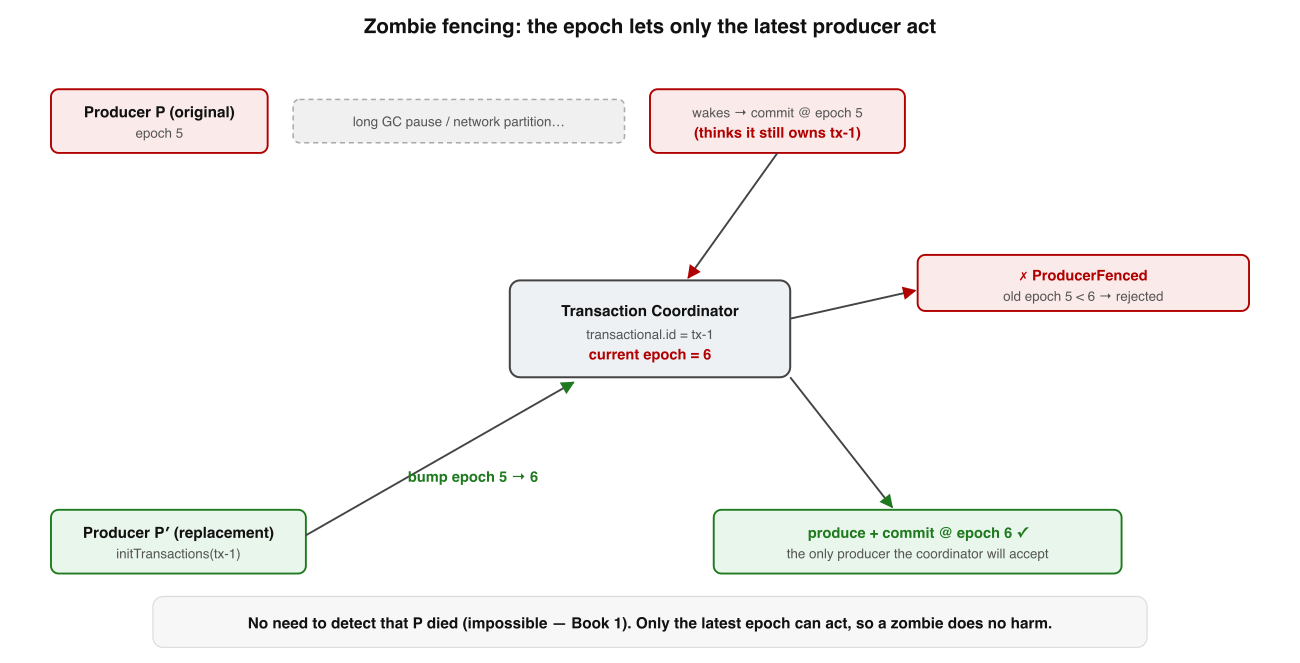
Zombie fencing via the epoch. Two producers share a transactional.id. The replacement’s initTransactions bumps the epoch; the coordinator now rejects anything from the old epoch. When the zombie wakes and tries to commit, it is fenced — ProducerFenced — and cannot corrupt the output.
The hazard A GC pause / partition makes the orchestrator declare
tx-1 dead and start a replacement with the same
transactional.id. Two producers now think they own tx-1.
The fix: epoch The replacement’s initTransactions() keeps the PID
but
bumps the epoch (5→6) and aborts the old epoch’s open txn. Every
request at the old epoch → ProducerFenced /
InvalidProducerEpoch.
Why transactional.id must be stable
So the new instance reclaims the same identity and bumps the epoch — otherwise the zombie isn’t fenced.
The deep point EOS never has to correctly detect death (impossible, Lesson 1). It guarantees only the latest epoch can act, so a wrongly-declared-dead producer does no harm.
✓ It never detects death — it just rejects the old epoch; the zombie’s writes are refused
🧟 Memory rule: Same transactional.id → bumped epoch → only the latest epoch can act; the woken zombie commits at the old epoch and is fenced.
Memory check
- What gets bumped, and by what call? → the epoch, by the replacement's
initTransactions() - What error fences the zombie? →
ProducerFenced/InvalidProducerEpoch - Why does it dodge the FLP impossibility? → it never detects death, only enforces latest-epoch-wins
The boundary — where Kafka’s exactly-once stops
The part that keeps people honest: everything above is Kafka→process→Kafka. Step outside and it doesn’t apply.
External side effects The instant processing touches something outside Kafka, it’s not in the txn — a crash-and-retry can repeat it. Back to the dual-write problem: idempotency keys or the outbox pattern.
Kafka Streams wraps it processing.guarantee=exactly_once_v2 manages
the producer, the offset commit, and state-store changelog writes in-txn — so
even stateful joins/aggregations are EOS.
EOS v2 (KIP-447) One producer per stream thread (not per input partition) — what made it scale to large topologies. Prefer Streams over hand-rolling the loop.
The cost, measured Coordinator round-trips + commit markers;
commit.interval.ms (default 100 ms under EOS) trades latency vs overhead.
Confluent: low single-digit % throughput hit with batching — the real cost is latency.
✓ Only Kafka-to-Kafka; the DB / card / email still needs idempotency keys or an outbox
🧱 Memory rule: EOS is real and excellent — and it stops at the first byte that leaves Kafka. For that byte you owe an idempotency key or an outbox.
Memory check
- What covers the byte that leaves Kafka? → idempotency key on the call, or the outbox pattern
- What does
exactly_once_v2add over hand-rolling? → manages state-store changelog writes in-txn too - The real cost of EOS? → latency (commit interval + LSO stall), not throughput
Where each mechanism shows up — and what it buys
Grounding for the whiteboard: the mechanism, the config knob, and the failure it prevents.
| Mechanism | Config / API | Failure it prevents |
|---|---|---|
| Idempotent producer |
| Duplicate from a within-session retry after a network blip |
| Transaction |
| Torn write across partitions; offset committed but output lost (or vice-versa) |
| Isolation level | isolation.level=read_committed | Downstream reading aborted / in-flight records → leaked duplicates |
| Epoch fencing | stable | A zombie (slow-not-dead) producer committing a stale transaction |
| Streams EOS v2 | processing.guarantee=exactly_once_v2 | Stateful aggregation/join losing or double-applying on crash |
| Outbox / idempotency key | app-level (DB + relay, or dedup table) | External side effect (DB, card, email) repeated on retry |
Pattern to notice: EOS is a whole-pipeline property. Three knobs on the producer side, one on every consumer — and the moment a side effect leaves Kafka, you are back to Part 2’s answers. 5
Retrieval practice — mix the mechanisms
Reading builds fluency (feels familiar). Recall builds storage (lasts). Answer from memory — instant feedback.
Q1. The idempotent producer dedupes a retried batch when the broker sees a sequence number that is…
Q2. What makes the read-process-write loop exactly-once is that the transaction atomically includes…
Q3. A consumer reading a transactional topic with the default read_uncommitted isolation level…
Q4. A zombie producer cannot corrupt exactly-once because the replacement's initTransactions()…
Q5. Your pipeline produces transactionally but still emits duplicates downstream. Most likely cause?
Q6. Your processing also writes a row to Postgres. Kafka EOS covers that write…
Reconstruct the guarantee from a blank page
Write the four interlocking mechanisms in order, one line each, then the boundary — with nothing on screen. Reveal and compare; gaps are your next drill.
1 Idempotent producer: per-(PID,partition) seq numbers dedup retries (≤last drop,
last+1 accept, >last+1 gap) · 2 Transaction: output +
sendOffsetsToTransaction commit all-or-nothing; commit markers to every
partition · 3 read_committed: reader stops at LSO, filters aborted — EOS
is a whole-pipeline property · 4 Epoch fencing: stable
transactional.id bumps the epoch; old epoch → ProducerFenced ·
5
Boundary: stops at the first byte leaving Kafka → idempotency key or outbox.
I’m your teacher — ask me anything. Say “grill me on Kafka EOS” for mixed no-clue questions, or describe a real pipeline and I’ll trace where it’s genuinely exactly-once and where it silently leaks. Want the crash-trace walked step by step, or the next lesson with spaced drills? Just ask.
Interview — pick your bar
Answer out loud in ~60s, then reveal. Core = recall · Senior = trade-offs & failure modes · Staff = synthesis under ambiguity · System Design = open design round (a different axis, not a harder level).
"Exactly-once in Kafka" — exactly-once what? Define the scope precisely.
What does the idempotent producer do, and what does it require?
(PID, partition) so a retried produce is deduped at the broker. It requires acks=all and bounded in-flight requests to preserve ordering, and it is scoped to a single producer session — a restart re-PIDs, so the idempotent producer alone does not survive a crash.What is read_committed, and why must every consumer set it for EOS?
read_committed makes the consumer skip aborted and still-open transactional records and stop at the Last Stable Offset, so it only sees committed output. The default is read_uncommitted, which returns aborted + in-flight records. EOS is a whole-pipeline property: a transactional producer with a default-isolation consumer is not exactly-once.Where are consumer offsets stored, and why does that matter for transactions?
__consumer_offsets topic, keyed by group/partition — a regular Kafka topic. Because the input offset is itself just another Kafka write, it can be enrolled in the same producer transaction via sendOffsetsToTransaction, which is exactly what lets "we consumed these inputs" commit atomically with the output.Walk me through how a per-partition sequence number dedupes a producer retry.
(PID, partition); seq ≤ last → ACK but discard (the dedup), = last+1 → accept, > last+1 → reject OutOfOrderSequence (a gap = lost data). Bonus: needs acks=all + bounded in-flight to keep ordering; scoped to one PID, so a restart re-PIDs and this alone doesn't survive it.Why does committing the consumer's input offset inside the producer's transaction make the loop exactly-once?
sendOffsetsToTransaction writes the offset to __consumer_offsets as part of the txn, so output and "we consumed those inputs" commit together or not at all. Crash before commit → both abort → restart reprocesses from the last committed offset, partial output is aborted/invisible. It's the dual-write problem solved only because both writes are in Kafka.I produce transactionally but downstream still sees duplicates. Diagnose it.
read_uncommitted, which returns aborted + in-flight records. EOS is a whole-pipeline property — txnal producer and read_committed consumer. The half-measure passes testing and duplicates in prod.What's the LSO, and what does read_committed cost you?
read_committed consumer never reads past it and filters aborted records via markers. Cost: a long-running transaction stalls its consumers at the LSO — read latency bounded by how long transactions stay open.What is a "zombie" producer, and how does Kafka stop it without solving failure detection?
transactional.id. Fix: initTransactions() bumps the epoch and aborts the old open txn; the coordinator rejects the old epoch (ProducerFenced/InvalidProducerEpoch). It never detects death — only the latest epoch can act, dodging the FLP/"slow vs dead" impossibility.Your processing also writes to a SQL DB and charges a card. How far does Kafka EOS get you?
Distinguish the two failure modes — a duplicate and a gap — in the EOS machinery.
seq > last+1 (OutOfOrderSequence) or an offset committed before its work ran (at-most-once). Duplicates are recoverable; gaps are not — which is why the safe default is at-least-once + idempotency, never commit-before-process.- State the scope up front: exactly-once effects for read-process-write, Kafka-to-Kafka; anything leaving Kafka is out of the transaction.
- Configure the producer: stable, instance-unique
transactional.id; idempotence on;acks=all; bounded in-flight. - Configure every downstream consumer
read_committed— call out that omitting this silently breaks EOS. - Show the atomic loop: consume → process → produce +
sendOffsetsToTransaction→commitTransaction. - Handle restarts with epoch fencing; for stateful work prefer Kafka Streams
exactly_once_v2(KIP-447). - Gate any external side effect behind an idempotency key or the outbox pattern.
- Name the cost: long transactions stall consumers at the LSO; tune
commit.interval.msfor latency vs overhead.
Design an exactly-once enrichment job (Kafka in, enrich, Kafka out).
transactional.id; the loop = consume → process → produce + sendOffsetsToTransaction → commitTransaction; downstream consumers set read_committed; commit.interval.ms tuned for latency vs overhead; epoch fencing relied on for restarts; Kafka Streams exactly_once_v2 if state is involved; and any external side effect gated behind an idempotency key/outbox. The candidate should name the boundary explicitly: EOS stops at the first byte leaving Kafka.Design an exactly-once pipeline whose last step charges a payment provider.
★ Cheat sheet — claim → what it actually means
Mental models: Idempotent producer = sequence numbers dedup retries ·
Transaction = output + input-offset commit atomically · read_committed = reader
honors the txn · Epoch = latest-instance-wins fencing · Boundary = stops at Kafka’s edge.
Translation table
| Claim / buzzword | What it actually is |
|---|---|
| ”Exactly-once delivery” | Impossible; Kafka gives exactly-once effects for read-process-write |
| Idempotent producer | Per- |
| Kafka transaction | Atomic multi-partition write plus the consumer input-offset commit |
read_committed | Stop at LSO + filter aborted records; required on every consumer |
| Zombie fencing | Epoch bump → only the latest |
exactly_once_v2 | Streams wraps producer + offsets + state changelog (KIP-447, 1 producer/thread) |
| EOS “is end-to-end” | No — stops at the first byte leaving Kafka; use idempotency key / outbox |
Three rules for the design review
① EOS is a whole-pipeline property — a txnal producer with a
read_uncommitted consumer is not EOS. ② Fencing
never detects death; it enforces latest-epoch-wins, so a stable
transactional.id is mandatory. ③ The moment a side effect
leaves Kafka, you owe an idempotency key or an outbox.
★ Review guides & what to read next
5-min (weekly) Don’t re-read — recall. Say the one sentence; redraw the EOS loop with the dashed transaction; recite the three broker seq-number verdicts and the epoch-fencing rule; name the boundary.
30-min (when stalled) Blank-page reconstruct all four mechanisms + boundary; trace a pre-commit crash end to end; then place one real pipeline — where is it genuinely EOS, and where does it leak?
Read next, in order:①
Confluent — Exactly-Once Semantics Are Possible
(the canonical write-up) · ②
KIP-98
&
KIP-447
(the design) · ③
Kafka docs — message delivery semantics
· ④ Kleppmann, DDIA ch.11 (the boundary argument).
These notes reflect my current understanding and are updated as I learn, build, and discover better explanations.